Research

SANKOFA: Slavery Heritage Sites, Oral History, and Reparative Knowledge System toward Decolonial Education

Faculty and units involved: Eric Kyere (School of Social Work); Emmanuel Saboro (Centre for African and International Studies, University of Cape Coast, Ghana)

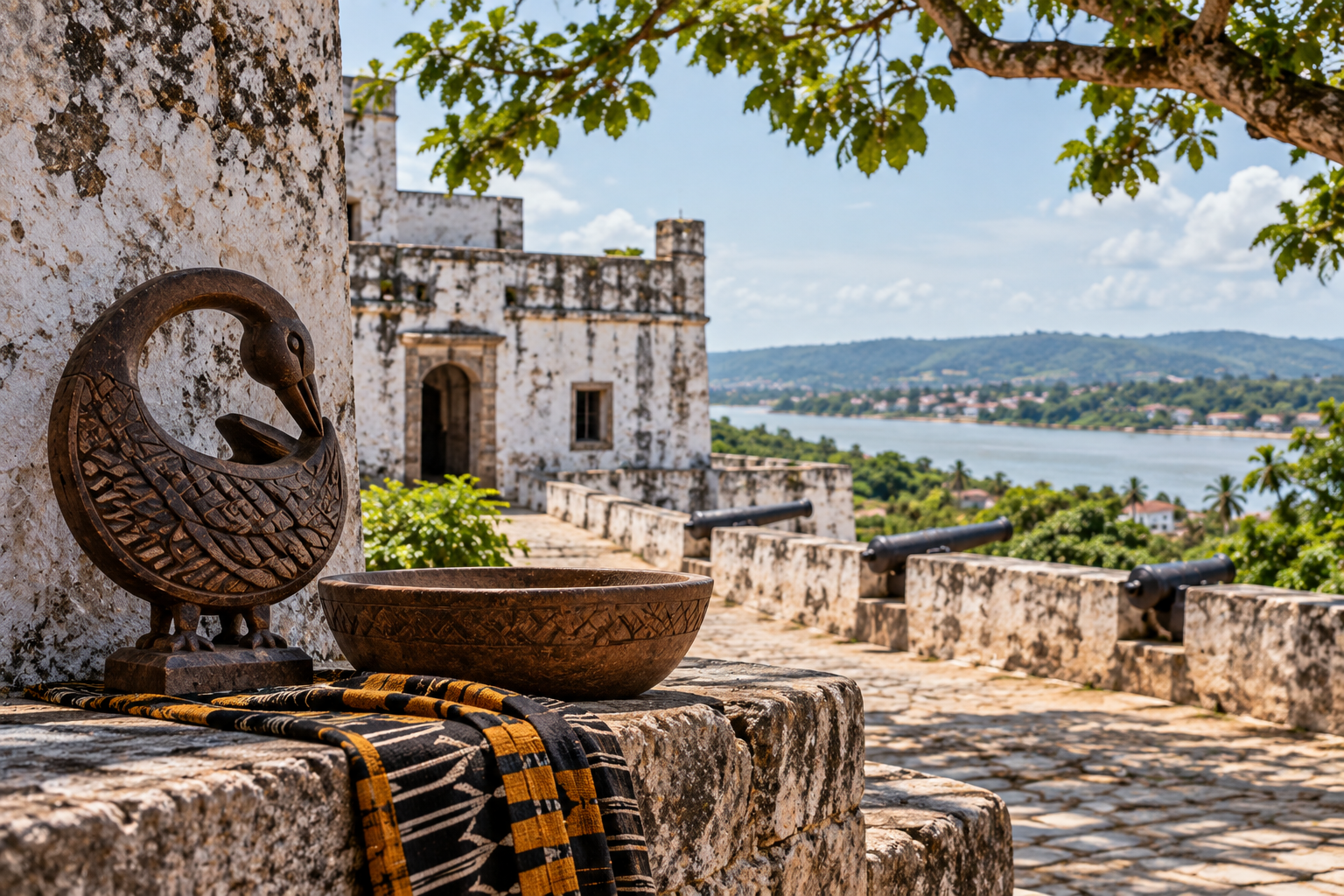
Traditional Ghanaian bird sculpture, patterned textile, and carved bowl displayed at a historic coastal fort overlooking cannons, lush hills, and the ocean.

Rooted in the Akan concept of Sankofa—the understanding that knowledge of the past is essential to interpreting the present and shaping the future—this project examines the theoretical and practical potential of slavery heritage sites in Northern Ghana as resources for reparative education. The study explores how these sites can generate forms of knowledge that challenge enduring colonial frameworks, deepen historical consciousness, and strengthen students’ capacity to imagine more just and transformative futures. Integrating social science methodologies with historical inquiry and heritage studies, the project develops reparative epistemic resources for curriculum and educational design, refines methodological approaches for identifying the pedagogical possibilities embedded within slavery heritage sites, and advances new research at the intersection of heritage, memory, and education. The work also supports the development of external funding proposals focused on the role of slavery heritage sites in reparative curriculum and pedagogy. Ultimately, the project seeks to produce curricular and pedagogical tools that cultivate agency, historical understanding, and more equitable educational practices while contributing to broader processes of community and societal transformation.

Funded through an IAHI Collaborative research grant.

Previous Research Projects

Faculty and units involved: Jason M. Kelly (History, School of Liberal Arts; IAHI); Lasana D. Kazembe (Urban Teacher Education, School of Education; Africana Studies); David Craig (Religious Studies, School of Liberal Arts); Kate Miller (World Languages, School of Liberal Arts); Audrey Ricke (Anthropology, School of Liberal Arts); Samuel Kahn (Philosophy, School of Liberal Arts); Ray Haberski (History and American Studies, School of Liberal Arts; IU Lab); David King (Lilly School of Philanthropy).

Global Ethics, Civic Character, and Leadership is an initiative to develop a humanities-based framework for character education at IU Indianapolis through an integrated undergraduate curriculum. The project centers on designing a two-course sequence focused on ethical reasoning, civic responsibility, and leadership, with the long-term goal of embedding this sequence within the undergraduate core curriculum. The primary activity is a 15-month faculty-led community of practice. This interdisciplinary group meets regularly to develop course content, align pedagogical approaches, and establish a shared framework for character education. The work draws on scholarship in virtue ethics, social psychology, and multicultural education, while also incorporating campus-wide consultation and external expertise.

Wake Forest’s Character Education Initiative supported the project from June 2025 to September 2026.

The Anthropocenes Network is an international, transdisciplinary, collaborative network of scholars in the sciences, social sciences, humanities, and arts; policy makers; community-based practitioners; and artists committed to developing innovative interventions in environmental research, pedagogy, and policy.

The network provides an infrastructure to pursue theoretical and applied scholarship in dialogue with experts across the disciplines. Affiliated research projects have a strong community-engagement component that ranges from the hyperlocal to the translocal.

  • Rivers of the Anthropocene
  • The Anthropocene Household
  • Voices from the Waterways
  • Anthropology of the Anthropocene
  • Museum of the Anthropocene

The Cultural Ecologies Project is a public research, learning, and residency program of the IU Indianapolis Arts & Humanities Institute (IAHI). It asks the seemingly simple question, “How do cultural interventions transform cities?” We work with community stakeholders to both develop and examine the impact of the arts and humanities across multiple scales — from the personal to the neighborhood to the city level. We develop new platforms for collaboration as well as new models for formal and informal learning. Our goal is to provide artists, cultural organizations, funders, policy makers, and others with:

  1. A central research center that can offer expertise in cultural planning, research, assessment, evaluation, and reporting.
  2. A suite of open access tools to help individuals and organizations continuously assess their cultural programming.
  3. Reports that contextualize Indianapolis’ arts and humanities environment within national and international conversations and practices.
  4. A model for cultural analysis and planning that can be replicated and scaled to meet the needs of other cities.
  5. An applied PhD program that supports the community by embedding students in cultural organizations and prepares them for jobs in the cultural sector.
  6. Residency programs that spark collaborations and investigate innovative approaches to equitable cultural action.
  7. Educational programs that develop new ways of thinking and doing.

Cultural Ecologies Research

Cultural Ecologies Public Programs

Cultural Ecologies Student Opportunities